
Packing List for International Travel: The Complete Checklist for Every Trip
A solid packing list for international travel comes down to five categories: travel documents, money and tech, clothing, toiletries and medications, and a small bag of emergency extras. Nail those five, and you can handle a delayed flight in Lisbon, a sudden cold snap in Tokyo, or a lost suitcase in Mexico City without panic. Skip one, and you’ll spend part of your trip shopping for things you already own.
Here’s the honest truth after years on the road: most travelers pack twice as much as they need and forget the ten things that actually matter. Your passport? Obviously. Your prescription meds in original packaging? People forget that one constantly, and it causes real problems at borders. A pen for customs forms? Small thing, big headache when 200 people are fighting over one airline pen.
This guide walks you through a complete packing list for international travel, section by section. You’ll find a printable-style checklist, a table that breaks down essentials versus nice-to-haves, and answers to the questions travelers ask most. So, let’s get into it before your next flight does.
Documents and Money: The Non-Negotiables

Start here, because documents are the one category you cannot buy replacements for mid-trip. First, check your passport expiration date. Many countries, including all 27 Schengen nations, require your passport to be valid for at least six months beyond your departure date. Then, make two copies of the photo page: one in your carry-on, one left with someone at home. Plus, snap a photo of it on your phone.
Next, gather these items into one document wallet before anything else goes in your suitcase:
- Passport (valid 6+ months beyond travel dates)
- Visa or eTA confirmation, if your destination requires one
- Travel insurance policy and emergency contact number
- Flight confirmations and hotel bookings (printed and digital)
- International driving permit, if you plan to rent a car
- Credit cards with no foreign transaction fees, plus a backup card
- Small amount of local currency for your arrival
On the money side, carry at least two payment methods and keep them in separate places. For example, keep one card in your wallet and another in your hotel safe or a hidden money belt. Cards get declined abroad for reasons that have nothing to do with your balance, so a backup saves the day. Also, call your bank or set a travel notice in your app before departure. Otherwise, fraud filters may freeze your card the first time you tap it in Bangkok.
Finally, tell your bank the exact dates and countries. That two-minute task prevents the most common money meltdown in international travel.
Clothing: Pack for the Trip You’re Taking, Not the Trip You Imagine
Clothing is where overpacking lives. Therefore, follow one rule: every top should match every bottom. Build around a single color palette, think navy, black, gray, and one accent color. As a result, a carry-on-sized wardrobe can produce two weeks of outfits.
For a one-week international trip to most destinations, this clothing core works well:
- 5-7 tops (mix of t-shirts and one or two nicer shirts)
- 2-3 bottoms (pants, shorts, or skirts depending on climate)
- 1 warm layer (fleece or light down jacket, even in summer)
- 1 rain shell or compact umbrella
- Underwear and socks for 5-7 days
- Sleepwear
- One pair of broken-in walking shoes plus one dressier or sandal option
- Swimwear and a quick-dry towel
- Sun hat and sunglasses
Moreover, check the dress codes at your destination. Churches in Italy, temples in Thailand, and some restaurants in Paris all require covered shoulders or knees. A lightweight scarf or long-sleeve shirt solves this for almost no packing space. Similarly, research the season carefully. For instance, Japan in April can swing from 55°F mornings to 75°F afternoons, so layers beat bulk every time. (If cherry blossom season is on your radar, our Japan travel itinerary covers what to expect month by month.)
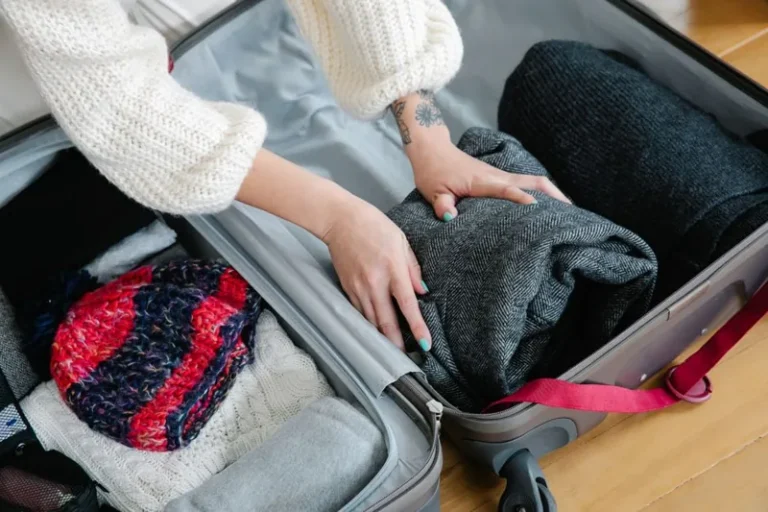
Roll your clothes instead of folding. In short, rolling saves roughly 30% more space and reduces wrinkles on natural fabrics. Packing cubes take this further by compressing outfits into grab-and-go bundles.
Toiletries, Medications, and Health Essentials
Medications come first in this category, not last. Bring all prescription meds in their original labeled containers, plus enough for your entire trip plus three extra days in case of delays. In addition, carry them in your carry-on, never checked luggage. Pharmacists abroad often can’t fill foreign prescriptions, so what you bring is what you have.
For the rest, think minimal and multipurpose:
- Toothbrush, toothpaste, floss
- Solid shampoo and soap bars (they skip the liquids rule entirely)
- Deodorant
- Sunscreen and lip balm with SPF
- Basic first aid: bandages, blister patches, pain reliever, antihistamine
- Motion sickness remedy if you’re prone
- Hand sanitizer and a few tissues
Remember the TSA-style 3-1-1 rule if you’re carrying liquids in your carry-on: containers of 3.4 ounces (100 ml) or less, all fitting in one quart-sized clear bag. Most international airports follow the same standard. Alternatively, buy liquids like shampoo and body wash at a pharmacy when you land. Boots in the UK, Watsons in Asia, and any European supermarket stock familiar brands for less than airport prices.
Also, pack a small health kit for your destination. For example, travelers to Southeast Asia should add oral rehydration salts and anti-diarrheal medicine. Meanwhile, high-altitude destinations like Cusco or Lhasa call for altitude sickness consults with your doctor before you fly.
Electronics and Tech Gear
Tech is personal, but a few items belong on every packing list for international travel. First, the adapter: check your destination’s plug type before you buy anything. Most of continental Europe uses Type C/F, the UK uses Type G, and Japan uses Type A/B. A single universal adapter with USB ports covers multi-country trips, though a small dedicated adapter is slimmer for single-country visits.
Second, check the voltage. Most modern phones, laptops, and camera chargers handle 100-240V automatically. However, hair dryers, curling irons, and electric kettles often don’t. Plug a 120V-only hair dryer into a 230V outlet, and you’ll burn it out instantly. Consequently, either buy a dual-voltage model or use the hotel’s.
Here’s the core tech kit:
- Universal power adapter (or destination-specific adapter)
- Phone and charger, plus a short USB cable
- Portable battery bank (under 100Wh to comply with airline rules)
- Noise-canceling earbuds or headphones
- E-reader or tablet for long flights
- Downloaded offline maps and translation packs
Notably, download offline Google Maps for your destination city before departure. Similarly, download a translation app’s offline language pack. Both work without data, and both have rescued more trips than any gadget ever sold.
The Ultimate Packing List for International Travel: Quick-Reference Table

Sometimes you just need the short version. Therefore, here’s the complete rundown, sorted by priority. Use it as your final sweep before you zip the suitcase.
| Category | Must-Pack Essentials | Nice to Have |
|---|---|---|
| Documents | Passport, visa, insurance, flight confirmations | Printed copies, international driving permit |
| Money | 2 credit cards, emergency cash in local currency | Backup card from a second network |
| Clothing | Versatile layers, walking shoes, rain shell | Packing cubes, quick-dry towel |
| Health | Prescription meds, first aid kit, sunscreen | Rehydration salts, sleep mask |
| Tech | Adapter, charger, power bank | Noise-canceling headphones, e-reader |
| Carry-On | Change of clothes, valuables, medications | Empty water bottle, snacks |
| Extras | Luggage locks, laundry bag, pen | Travel pillow, clothesline |
Above all, treat the carry-on column as sacred. If your checked bag vanishes in Frankfurt, your carry-on should carry everything you’d need for 48 hours on its own: one outfit, all medications, all documents, all electronics, and your chargers.
Carry-On Strategy and Checked Bag Tips
Your carry-on deserves as much planning as your main luggage. Ideally, pack it as a “trip within a trip.” That means a full change of clothes, your documents wallet, medications, electronics, and a toothbrush. Then, if the airline loses your checked bag, you can function comfortably for two days while it catches up with you.
In checked luggage, place anything you can replace easily. Meanwhile, skip these entirely in checked bags: medications, electronics, jewelry, cash, and important documents. Besides the loss risk, lithium batteries are banned from checked bags on nearly every major airline for fire safety reasons.
Weigh your bags at home with a luggage scale. Most international economy fares include one checked bag up to 50 lbs (23 kg), but low-cost carriers like those within Europe charge steep fees at the gate. Additionally, leave 10-15% of your bag empty on the way out. That space holds souvenirs, gifts, and the things you’ll inevitably buy. Alternatively, pack a foldable duffel as your overflow bag for the return.
For first-time travelers sorting out the bigger picture, our beginner’s guide to planning a trip pairs well with this checklist.
Destination-Specific Adjustments
No single packing list for international travel fits every trip. Rather, adjust by region and season. For instance, a two-week Europe trip in summer needs almost nothing heavy, but the same route in November demands a real coat and waterproof shoes. Our two-week Europe itinerary notes seasonal packing calls for each leg of a classic route.
Meanwhile, tropical destinations flip the script. Lightweight, loose, breathable fabrics replace layers entirely. In addition, insect repellent with 30% DEET, reef-safe sunscreen, and a fast-drying swimsuit cover-up earn their space. Conversely, ski trips and winter destinations call for serious insulation strategy: merino base layers, wool socks, and a proper down jacket you wear on the plane to save suitcase space.
Finally, check a few official sources before you finalize. The U.S. State Department’s country information pages list entry requirements, and IATA’s Travel Centre details passport and visa rules by nationality. Both take five minutes to check and prevent expensive surprises at check-in.
FAQ: Packing List for International Travel
What should I never pack in checked luggage?
Never check medications, passports or other travel documents, electronics, lithium batteries, cash, or jewelry. These items belong in your carry-on at all times. Besides theft and loss risk, airlines explicitly prohibit spare lithium batteries in checked bags. If it’s irreplaceable or essential, keep it with you.
How far in advance should I start packing for an international trip?
Start your list two weeks out and pack physically three days before departure. That buffer gives you time to buy missing items calmly, pick up prescriptions, and check your passport validity. Ultimately, last-minute packing is where essentials get left on the kitchen counter.
How do I pack light for a two-week international trip?
Pack a one-week wardrobe and plan to do laundry once. Choose a matching color palette, limit yourself to two pairs of shoes, and use packing cubes to stay organized. Merino wool and synthetic fabrics dry overnight after a hotel sink wash. As a result, many experienced travelers fit two weeks into a single carry-on.
Do I need travel insurance for international trips?
Yes, strongly consider it. Medical care abroad can cost thousands out of pocket, and most domestic health plans cover little or nothing internationally. Compare policies on a site like InsureMyTrip, and look for coverage that includes medical evacuation. Furthermore, some countries, like Schengen nations for long stays, require proof of insurance for visa approval.
Should I exchange currency before I leave home?
Exchange a small amount, roughly $50-100 equivalent, before departure for taxis and tips on arrival. After that, use ATMs at your destination for better rates than airport exchange kiosks. Likewise, choose to be charged in local currency whenever a card terminal asks. That “pay in dollars” option adds a hidden markup every time.
Final Thoughts: Pack the Checklist, Not the Fear
The best packing list for international travel is the one you trust. Build it once, save it on your phone, and tweak it after every trip. Over time, you’ll learn what you actually use and what just rides along dead weight. Most travelers discover they could cut a third of their luggage and miss nothing.
Start with documents and money, layer in versatile clothing, double-check medications, and keep a 48-hour survival kit in your carry-on. Beyond that, everything else is negotiable. So print the table above, lay everything on your bed, and cut before you pack. Ready for more? Explore Journeo’s trip-planning guides and turn that checklist into your next adventure.